
Quote to Cash
Connect quotations, sales orders, shipments, invoices, payments and finance in one controlled process.
Run finance, sales, purchasing, inventory, projects, operations and reporting through one connected cloud ERP—and give your teams greater visibility, stronger control and a better way to grow.
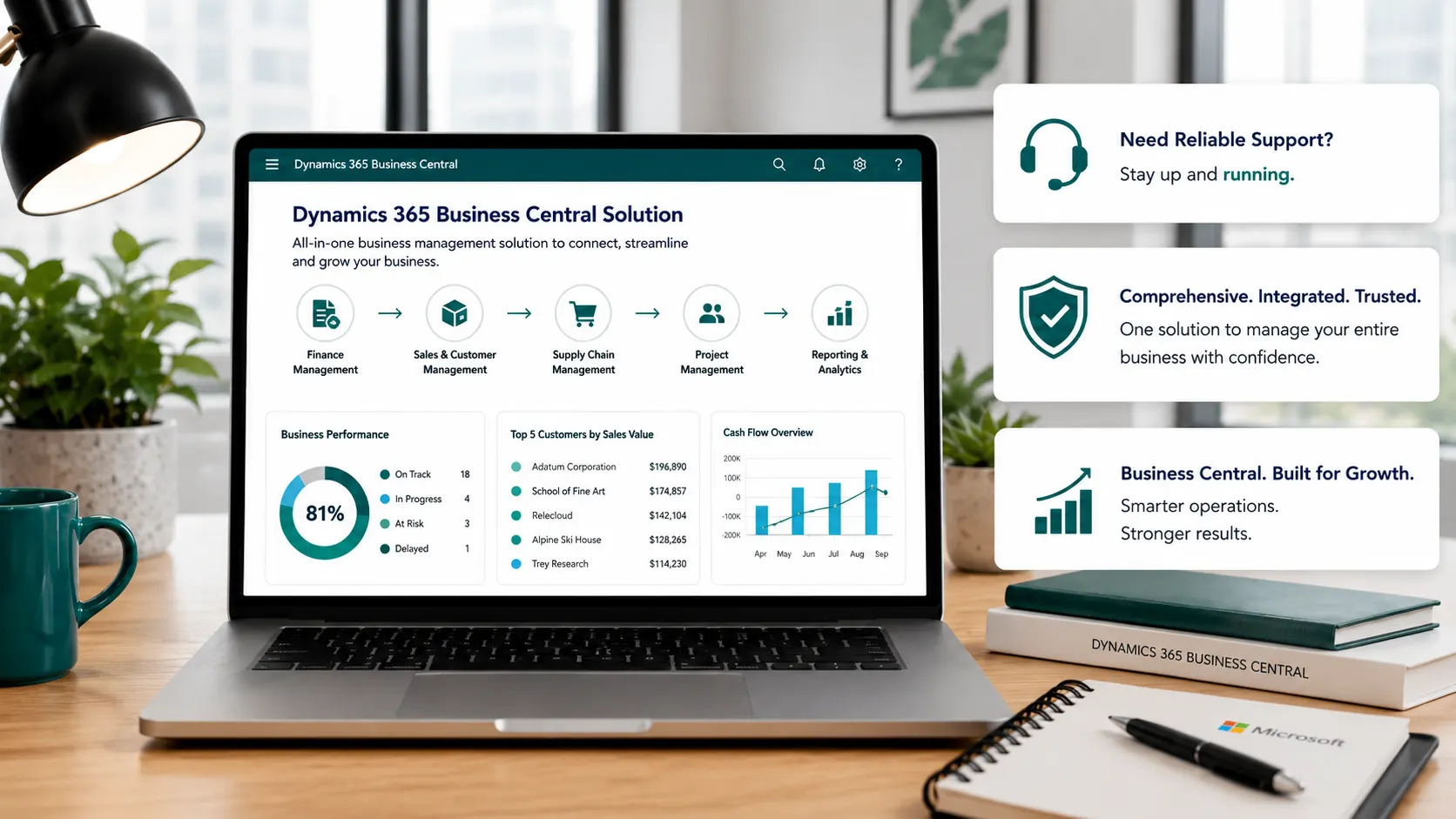
Many businesses do not realize they have outgrown their existing software until everyday work becomes difficult. Finance has one set of numbers, sales has another, inventory is managed somewhere else, approvals happen through email and management depends on spreadsheets.
The problem may not be your people. The problem may be that your systems are no longer connected. Business Central brings financial and operational information together in one modern ERP environment.
Business Central connects the transaction, the operational activity and the financial result so your teams can work from one version of the truth.
Connect quotations, sales orders, shipments, invoices, payments and finance in one controlled process.
Connect purchasing, approvals, receipts, inventory, vendor invoices and payments without separate trackers.
See stock, incoming supply, customer demand, transfers and location information from the same ERP.
Bring financial and operational data together so decisions do not depend on manually assembled reports.
Business Central connects the core areas of your organization so information can move with the transaction.
Accounting software may tell you revenue, cost and profit. A connected ERP helps explain why margin changed—through selling price, purchase cost, inventory, freight, production, discounting and operational activity. Business Central connects the financial result with the process that created it.
Give management faster access to information already being created through day-to-day operations.
Review bank position, outstanding customer balances and collection priorities.
Understand sales activity, customer transactions and order progress more quickly.
See available stock, incoming supply, demand, movement and purchase commitments.
Connect project budgets, costs, resources, billing and margin information.
Follow purchasing, warehouse, manufacturing or service activity from a shared system.
Use consistent ERP data for financial reports, Excel analysis and Power BI dashboards.
Multiple spreadsheets, separate systems, manual approvals, repeated data entry, delayed reports, limited inventory visibility and too much dependency on individual employees.
Central ERP information, connected transactions, structured workflows, better traceability, clearer operational visibility and more consistent reporting.
We do not start with software. We start by understanding how your business operates, what should remain standard and where configuration, migration, automation or customization is genuinely required.
Disconnected systems also consume time, create risk and make growth harder. The better question may be: what is the current way of working costing the business every year?
Time spent re-entering information, preparing reports and reconciling different systems.
Incorrect stock decisions, missed approvals, duplicate data and avoidable correction work.
Management waiting for departments to prepare and validate the latest information.
Systems that become harder to manage as users, locations, products and transaction volumes increase.
Not every organization needs a long ERP project. For businesses with a controlled scope and good readiness, Leaforge offers structured Rapid5 and Rapid8 implementation options. Broader requirements can follow a full implementation approach. The right route depends on your business—not simply the number of weeks.
Start with the business problem, then decide whether Business Central and the proposed implementation approach are the right fit.
No. Financial management is central to the platform, but Business Central can also support sales, purchasing, inventory, warehousing, projects, manufacturing, service management and reporting depending on configuration and licensing.
It is worth evaluating when accounting and operations are disconnected, spreadsheets carry critical processes, inventory visibility is weak, reporting is slow, transaction volumes are increasing or current software cannot support the next stage of growth.
Rapid5 and Rapid8 are predefined, standard-first options for organizations whose modules, data and readiness fit the package boundaries. A Full Implementation is more appropriate when the business needs deeper discovery, complex migration, integrations, extensions, multiple companies or phased process change.
Yes. Business Central supports configuration and extensions. Leaforge recommends keeping the solution standard wherever practical and customizing only where there is a clear, justified business requirement.
Yes. Existing Business Central environments can be reviewed and supported even when Leaforge did not perform the original implementation. Support can cover functional issues, users, reporting, integrations, customization review, release readiness and controlled improvements.
Yes. Business Central exposes supported integration options such as APIs, web services, connectors and extension points. The architecture should be selected around system ownership, transaction volume, security, error handling and which application remains the source of truth.
Yes. Leaforge can train users by role and process—for example finance, purchasing, sales, inventory, projects, service, manufacturing or reporting—using the configuration and working practices defined for the customer environment.
There is no single implementation price that fits every Business Central project. User roles and license type affect subscription cost, while migration, modules, integrations, customization, training and support determine the delivery effort. Leaforge can map these items before a commercial estimate is prepared.
Tell us what software you use today, where your teams are struggling and what management needs to see. We can help you determine whether Business Central is the right fit and what a practical implementation could look like.